Tuesday, July 19, 2011
So much for that
Well... my once-weekly update plan isn't working out. For once, it's not because I didn't want to. It's just that nothing much has changed yet. I finished the book, I'm still procrastinating my motor speech reading, I'm still knitting the same scarf. But on Thursday, I will be a homeowner! Super exciting.

Monday, July 11, 2011
Right Now
Currently reading: Prodigal Summer by Barbara Kingsolver. I got this book for cheap at a library sale. I read no summaries or anything before starting, just chose it because I've liked other works by the author. I like this one too, I think. I've enjoyed watching the 4 separate story lines spiral in toward each other, I'm just not sure where it's really going. That's fine, though. It's a pleasant summer read so far.
Currently knitting: A Bakus scarf in a truly beautiful purple alpaca yarn.
Currently procrastinating: The 65 page reading assignment I have to do before a quiz tomorrow in Motor Speech Disorders.
Currently wishing: That I could go to the pool instead of reading. Or that it was not 100 degrees out so I could go for a walk.
Currently grateful for: An air-conditioned home and a big plastic tub full of pretty yarn.
Currently knitting: A Bakus scarf in a truly beautiful purple alpaca yarn.
Currently procrastinating: The 65 page reading assignment I have to do before a quiz tomorrow in Motor Speech Disorders.
Currently wishing: That I could go to the pool instead of reading. Or that it was not 100 degrees out so I could go for a walk.
Currently grateful for: An air-conditioned home and a big plastic tub full of pretty yarn.
Tuesday, May 10, 2011
Done, Done, Done!
The first year of graduate school is DONE!!!!
It's been a year since this
 happened, and in another year, it will happen again, for the last time. I can't wait.
It's been a year since this

Friday, September 10, 2010
If the skies above you are gray
I'm struggling a little bit today. I'm homesick for where I moved from, or where my parents live, or even where Steven's parents live...really just anywhere that's ever felt like home. I didn't get enough sleep and I'm worn out. I have work I absolutely must accomplish this morning, but I don't feel well and I'm having such a hard time concentrating and figuring out what exactly needs to be done. I just want to go back to bed for a while, but that's not an option at all. I have to get through this day. I'm trying to hold it together, but it's not going well. "I am poured out like water, and all my bones are out of joint; my heart is like wax; it is melted within me." BUT "I waited patiently for the LORD; and He inclined to me and heard my cry. He brought me up out of the pit of destruction, out of the miry clay, and He set my feet upon a rock making my footsteps firm. He put a new song in my mouth, a song of praise to our God; Many will see and fear and will trust in the LORD."
Tuesday, August 10, 2010
New Creations
I finished the rug!
 It has its flaws, partly because it's the first one I've done and partly because I just didn't care enough to try to make it perfect. It's at home now on the bathroom floor, and I am simply not of the opinion that things that belong on the bathroom floor have any reason to be perfect. Overall, I'm pretty pleased with how it came out and definitely pleased that I made it myself, and in two days, no less!
The creative ability God gave people is amazing. I'm far from what you would normally call a "creative person." I can't draw or paint well, I don't sew well, I don't have fabulous design sense, my decorated cakes never fail to be ugly, I couldn't write a decent story to save my life, and I'm not even great at my passion, knitting. But I'm coming to realize that I don't need special talent to create things. I may not have talent, but I do have ability. I am capable of creating things that I find beautiful, or useful, or unique, or thrifty, or some other valuable quality. I can recognize that when I don't have extra money, and I don't have a bathroom rug, but I do have some scrap cloth, I can make my own rug. Or I want some winter wear to keep me extra-warm, and the stores don't sell what I want - I can make a wool hat, mittens, even a sweater, with exactly the material and appearance I want. I love even more that when I create something, it's like a little tiny version of what God did and does as the Creator. I love that He made His creation creative.
A little cooking note - I made red beans and rice for the first time ever tonight, at Steven's request. They turned out surprisingly good. Here's the recipe-ish thing I used (really a compilation and paring down of recipes from the internet).

The creative ability God gave people is amazing. I'm far from what you would normally call a "creative person." I can't draw or paint well, I don't sew well, I don't have fabulous design sense, my decorated cakes never fail to be ugly, I couldn't write a decent story to save my life, and I'm not even great at my passion, knitting. But I'm coming to realize that I don't need special talent to create things. I may not have talent, but I do have ability. I am capable of creating things that I find beautiful, or useful, or unique, or thrifty, or some other valuable quality. I can recognize that when I don't have extra money, and I don't have a bathroom rug, but I do have some scrap cloth, I can make my own rug. Or I want some winter wear to keep me extra-warm, and the stores don't sell what I want - I can make a wool hat, mittens, even a sweater, with exactly the material and appearance I want. I love even more that when I create something, it's like a little tiny version of what God did and does as the Creator. I love that He made His creation creative.
A little cooking note - I made red beans and rice for the first time ever tonight, at Steven's request. They turned out surprisingly good. Here's the recipe-ish thing I used (really a compilation and paring down of recipes from the internet).
Soak 1/2 dry red beans all day, then boil those for about an hour, then drain and add fresh water. In the meantime, sauté 3 celery ribs and some chopped onion (maybe 1/2 cup) in 1 tbs. butter. Add that to the beans, along with 1/2 pound smoked sausage, a bay leaf, a little Worcestershire sauce, and a few shakes of Tony's seasoning. Cook 1/2 c. (dry) brown rice separately. In an hour and a half or so, enjoy!
Monday, August 9, 2010
Something old, new, borrowed and blue
That has nothing to do with a wedding.
I'm trying out a new craft. A month or so ago, I got an impulse to make a braided rug. I really can't remember what made me think of such; I've never even known someone who made one. I looked up a bunch of tutorials on the internet. When Steven gathered up some old clothes he was ready to throw out, I cut them up into long strips. I put it all in a bag and brought it with me to the new place, and finally today I got it out and start working on my braid.
 I tied a loop to that closet doorknob to hold the braid steady until it got long enough to weigh itself down, and sat in the corner and braided, attached new strips of fabric as needed using a method I saw once on a blog that I can no longer locate. The fabric is all from old jeans and tshirts. The idea is that the center of the rug will be white, spiraling out to light blue, then dark blue. I'm finding that the jersey knit from the tshirts handles much more neatly than the denim, not that that's a big surprise. After a while, I sewed up the beginning end, cut off the extra fabric, and wound up what I had done so far to see how big a rug I had. Here's what that looked like:
 I kind of wish I had started coiling it sooner - I would have done more of the light blue, because it's not as big yet as I want it to be. It will work out fine to have a larger dark band, though. I'll probably also try it out as an oval shape before sewing it up, to make sure I wouldn't rather have it that way. I plan to put the rug in front of my bathroom sink. I just love making things, and it's especially neat to take stuff that was headed for the landfill and create something attractive and practical out of it.
I'm trying out a new craft. A month or so ago, I got an impulse to make a braided rug. I really can't remember what made me think of such; I've never even known someone who made one. I looked up a bunch of tutorials on the internet. When Steven gathered up some old clothes he was ready to throw out, I cut them up into long strips. I put it all in a bag and brought it with me to the new place, and finally today I got it out and start working on my braid.


Sunday, August 8, 2010
Umm...Hi.
Okay, well, this blogging thing hasn't worked out like I had in mind. Namely, I had actual blogging in mind, and it hasn't worked out in that I haven't done it. In brief, here are some things I meant to cover in the recent non-existent posts.


Post 1: Steven and I had some people over a couple of weeks before moving. I made a cake for the occasion. It became, through a series of poor choices, accidents, and general misfortune, the ugliest cake I've ever made.
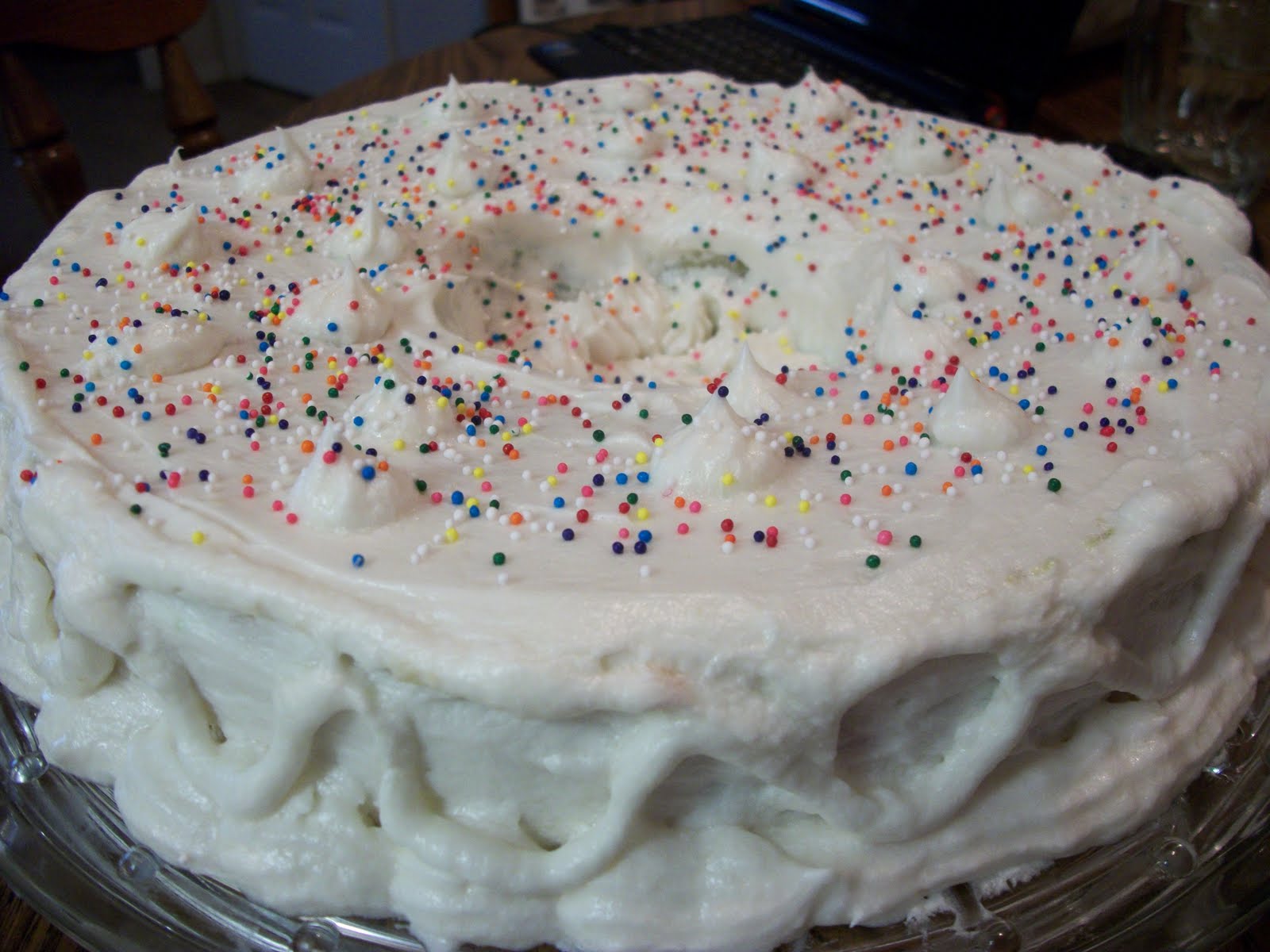
Seriously, it was bad. And if that doesn't convey the full horribleness of the cake, then know that it was not intended to be a bundt cake. It was flat; the middle didn't get done, and I scraped it out and covered it with icing. Too much icing, producing the "ant farm" look seen here:

On the bright side, everyone liked the sprinkles and enjoyed the moistness of the cake. I think "moist" does sound much better than "undercooked."
Post 2: We moved from here

With all of this

To Fayetteville. I don't have a picture for that yet. Also, that "upstairs fragile" label was not ours. We don't have an upstairs, but we did have a lot of boxes leftover from someone else's move. We were completely unpacked within a few days, and we're very comfortable here. We've spent time with a couple of old friends, made some new friends through visiting different churches, and learned our way around, at least to the main places we have any need to reach. Now we're mostly just looking forward to the start of school and our time as graduate students. At least, I think I'm looking forward to it...
Post 3:
I've been knitting a little. I've been working on this scarf/shawl, using the pattern Gabriel's Wings.

I've been adjusting the width of the stockinette and garter bands as I go to suit my taste. I rather like the way it looks with the stockinette bands getting wider with every repeat. So far I've only narrowed the garter to three ridges, but I may bring it down to 2 as I get closer to the end.
Post 4: I went to the Farmer's Market yesterday. It was very different than Searcy's, in that it was much bigger with a wide range of people. The best way I can put it is that it didn't feel like I was in Arkansas anymore. I bought some corn, purple-hull peas, and potatoes, and supplemented those with grocery store carrots, celery, onion, and vegetable broth, and made a really delicious vegetable soup. I love a good hearty soup, even in the summer. I also love it when I manage to pull off a good meal where all the vegetables are properly done, not crunchy or mushy, the cornbread is golden and just right, and it's all on the table by six o'clock. It seems to happen so rarely that it's a big thrill when it does.
And returning to my current post. I'm trying to focus my attention this evening on re-learning the International Phonetic Alphabet. I expect to be tested on it at either orientation or the first day of classes, and I also expect that doing poorly on that test will require me to retake a class on phonetics. I do not want to do that, so here I am, studying before school even starts. Ah well. At least it gives me a focus for the last few days of summer - I'd probably be a little down if I didn't know what I needed to be getting done.
Thursday, July 8, 2010
Bienveillance
I wouldn't say that "avec des cris de joie" fully describes my life just yet. With shouts of joy, because your bienveillance is better than life. Bienveillance is a good word. It's French, and it literally breaks down into "good watching over." We translate "love" or "lovingkindness" in English, but I like bienveillance best. God is watching over me, better than anyone ever could, and that loving protection is better than life itself. His bienveillance does cover my whole life, and because of it, I say with the psalmist, my lips will praise You.
But because my words are insufficient, I want my whole being to praise Him. Here I have a place to describe relationships and interactions, work, knitting, cooking, reflections on life. All of this can be praise for the Creator, and I hope it will. I hope, too, that I will be shouting for joy more and more, because His bienveillance est meilleure que la vie. In the end, all the things that go wrong in life don't matter. He is watching over, and I will seek a life of praise.
But because my words are insufficient, I want my whole being to praise Him. Here I have a place to describe relationships and interactions, work, knitting, cooking, reflections on life. All of this can be praise for the Creator, and I hope it will. I hope, too, that I will be shouting for joy more and more, because His bienveillance est meilleure que la vie. In the end, all the things that go wrong in life don't matter. He is watching over, and I will seek a life of praise.
Subscribe to:
Posts (Atom)